English
Take me to the site© 2026 Rentokil Initial plc and subject to the conditions in the Legal Statement.
For many people, getting Covid is their first taste of what it would like to lose their sense of smell, Known as “anosmia”, loss of smell can lead to a substantial consequence to our wellbeing.
Being under-estimated for a long time, the sense of smell has been proved by the scientists as a critical indicator of brain health. Moreover, researches indicate that despite the temporary loss of smell has already being a torture, pollutions in the air is gradually eroding our smelling ability, making a tremendous damage in a long run.
Since Feb 27 is the Anosmia Awareness Day, we are here to share with you how air borne particles affects our health like an invisible assassin, and how we can avoid being targeted in this decades long see-saw battle.
The air around us may appear to be clean, but it carries many types of microscopic particles, such as mineral particles, water droplets, pollen, various kinds of biological material and man-made pollutants, that can’t be seen by the human eye. These particles can transport microorganisms, allergens and toxins that cause a wide range of diseases in both humans and animals.
Diseases are more visible, they weaken your physical performance and can be quickly alleviated thanks to highly trained immune system by vaccines. However, air pollution, whose damage seems to be a cliché, are still unrecognized to the public to what extent it affects our day to day life.
Particle pollution, also called particulate matter (PM), is ranked by size:
Particles up to 10 μm (microns). These include airborne viruses, bacteria, smoke, dust, and mold spores.Particles up to 10 μm (microns). These include airborne viruses, bacteria, smoke, dust, and mold spores.
PM10 particles are small enough to pass through the throat and nose and enter the lungs. Once inhaled, these particles can affect the heart and lungs and cause cardiovascular and respiratory diseases.
Particles up to 2.5 μm. These are likely to be particles from power plants, vehicle exhausts, wildfires, and other types of combustion.
These particles are so small they can get deep into the lungs and into the bloodstream. Long exposure to PM2.5 particles can cause serious health effects.
Particles up to 0.1 μm. This is ultra-fine dust particles, largely from the same sources as PM 2.5 particles, but much finer. They are the most common indoor particles.
PM 2.5 is the most commonly quoted index of air quality level. Previously PM 2.5 is lined with industrial and occupational diseases as construction or factory workers are most likely exposed under high density of this extremely small airborne pollution particle.
But researches point out that the air we breathes every day, although may only contain very small amount of particle pollutants, are still relevant to the eroding of our senses like smelling.
In 2009, scientists investigated the prevalence of olfactory dysfunction in a sample of 1900 adult Swedish population and found out that the overall prevalence of olfactory dysfunction was 19.1%, 5.8% of which is identified as anosmia. Bear in mind that the average PM 2.5 of Skövde, Sweden is 2 µg/m³ (1)
Another research published in 2012 investigated the relevance of associations between fine particles and mortality in the Harvard Six Cities from 1974 to 2009.
Result indicates that since 2001, average PM2.5 levels, for all six cities, were < 18 µg/m3. Each 10 µg/m3 increase in PM2.5 was linked with an increased risk of all-cause mortality of 14%, and with 26 and 37% increases in cardiovascular and lung-cancer mortality respectively.

If the clean air condition in Sweden (Pm2.5: 2 µg/m³) cannot prevent its citizens from olfactory dysfunction, it is not hard to imagine how Harvard Six Cities will witnessed a higher level of anosmia relevant to PM 2.5 increasing. In another words, if the higher PM 2.5 links with more cases of anosmia and higher mortality rate, could we consider anosmia an indicator to more morality rate as they are both the result of PM 2.5 increasing. (2)
This is not an hypothesis according to recent studies. Mounting evidence seems to link a variety of neurological problems to dirty air. Troubling recent findings include hallmarks of Alzheimer's disease found in the brains of children living in Mexico City (3) and a nearly doubled risk of dementias for older women in highly polluted parts of the United States (4).
The finding has been echoed in other parts of the world in studies published this year. One recent study in Brescia, northern Italy, for example, found the noses of teenagers and young adults became less sensitive to smells the more nitrogen dioxide – another pollutant produced when fossil fuels are burned, in particular from vehicle engines – they were exposed to. Another year-long study in São Paulo, Brazil, also indicated that people living in areas with higher particulate pollution had an impaired sense of smell.
Anosmia is one of the first symptoms of Alzheimer, with 90% of patients have anosmia by the time Alzheimer is diagnosed.
This maybe because smell and taste are linked to memory. And the loss of smell is the first sign that the neuro-system has been damaged due to long time invasion of small particles.

After Covid pandemic, people’s behaviour has been significantly changed. The air quality control has been a must in many public areas like offices and schools. While air purification in pandemic is considered to be an emergency measure which would probably be relaxed due to normalization of daily life, the measurements of reducing air borne particles other than viruses should be kept as a long term health strategy.
You should also care about workplace or resident mold infestation problem due to the fact that mold spores are catogoraized in PM10 as a crucial pathogen of indoor air hygiene. See how our mold removal service can help you to reduce mold threat in a long run.
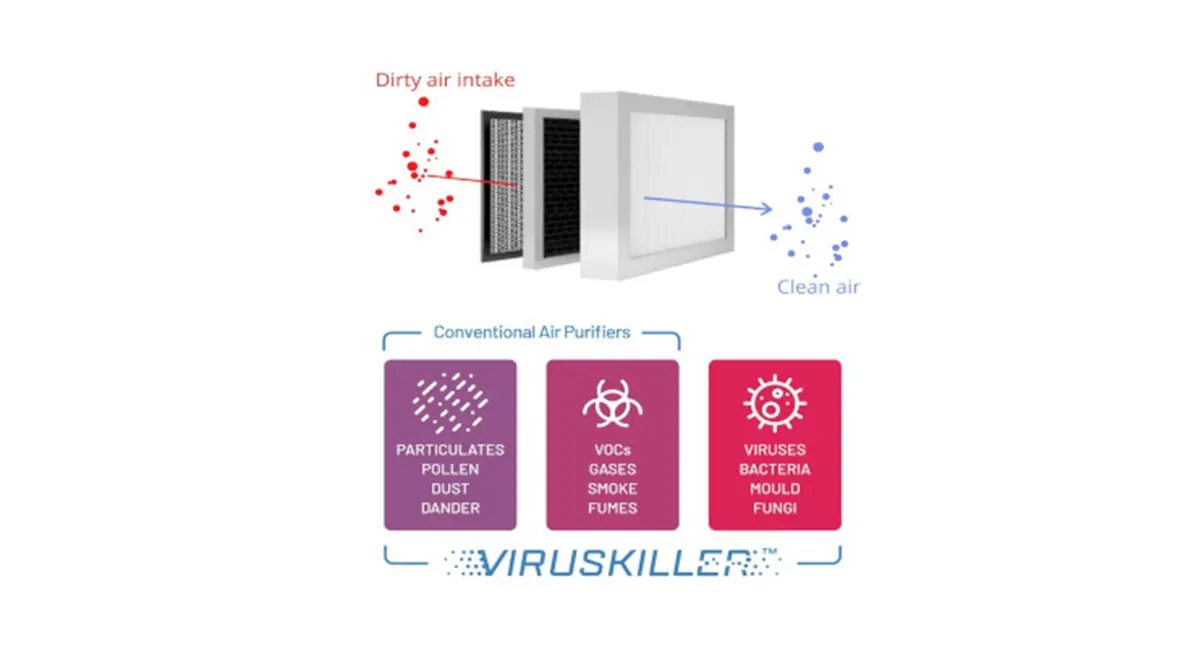
Check out our VIRUSKILLER air purifier range. See how to prevent day to day tiny particle pollution in a long run.
As we enter this new post-pandemic era, give your workers and customers the reassurance they need to feel safe in your space. Take steps now to address indoor air quality with an air purification system like VIRUSKILLER.
Doing so won’t just help you get back to business faster, it will help your organisation be better prepared to weather future health crises.
(1) Prevalence of Olfactory Dysfunction: The Skövde Population-Based Study
(2) Chronic exposure to fine particles and mortality: an extended follow-up of the Harvard Six Cities study from 1974 to 2009
(3) Hallmarks of Alzheimer disease are evolving relentlessly in Metropolitan Mexico City infants, children and young adults.
(4) Particulate air pollutants, APOE alleles and their contributions to cognitive impairment in older women and to amyloidogenesis in experimental models
Enhance the employee and customer satisfaction and wellbeing with Initial’s Premium Scenting solutions.