myInitial
Manage your business
myInitial login
Step into a washroom, and what’s the first thing you notice? For many people, it’s how it
smells. This makes sense — research has found that smells can impact how we think, feel
and act in specific settings. For your business, this means that washroom fragrancing can
have a positive effect.
When 77% of people judge a business more or less favourably based on their washrooms¹, a
pleasant-smelling washroom can make a big difference, while malodour can have the
opposite effect. A well-fragranced washroom can help reassure customers or employees
that facilities are clean and hygienic, improve user experiences and encourage positive
brand impressions.
When choosing a washroom fragrancing solution that works for your business, you should
consider things like room sizes, dispersal methods and scent options. If you’re looking for
fragrancing for small washrooms, a product for individual cubicles or a solution that doesn’t
need batteries, mains power, aerosols or propellants, a passive air freshener could be the
perfect option.
In this blog, you’ll explore passive air freshening through the eyes of our innovators. We’ll
show you how we developed our new solution so that you can see how airflow can help
your washroom fragrancing go battery-free.
Before we get into the innovation, let’s clarify what passive fragrancing means. The
difference between ‘active’ and ‘passive’ devices is how they distribute scent.
Passive fragrancing devices are ideal for small washrooms or individual cubicles, and they
can be a great option if you’d like to reduce your battery or energy usage. Their flexibility
and design, which don’t need electricity, can also make them a good fit for tiled washrooms
or other spaces that can’t take a wired solution.
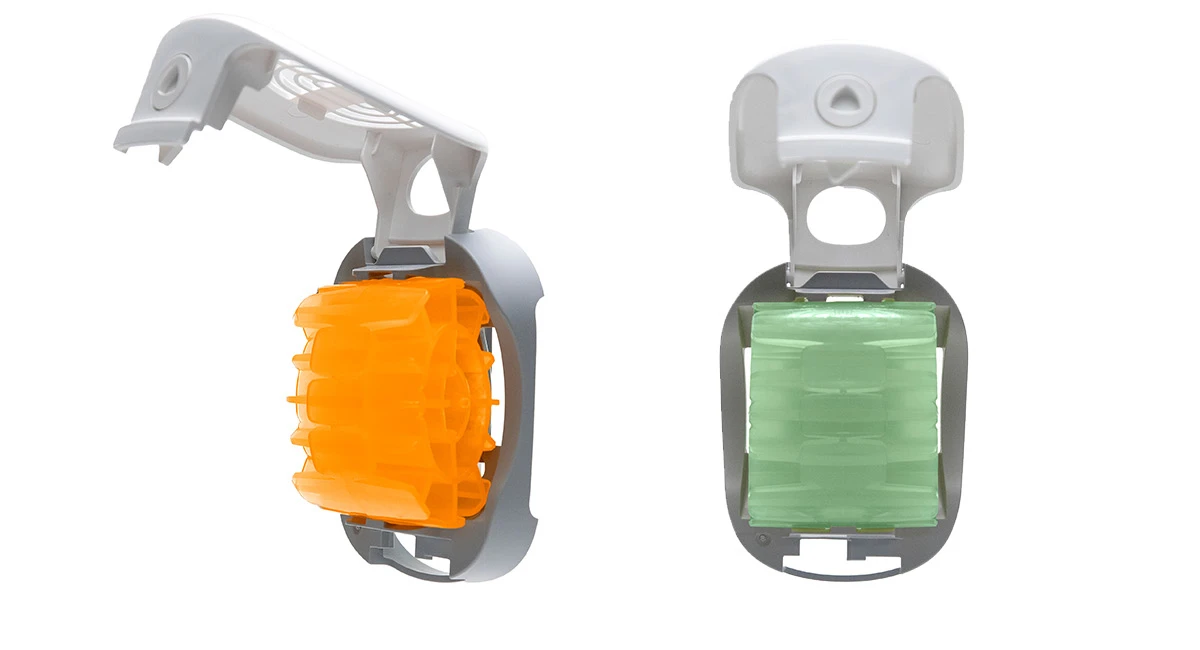
Passive air fresheners come in different shapes and sizes — potpourri, reed diffusers and
lavender bags are some you might find in your home. Like these solutions, we chose air as
the ‘power’ behind our passive device, so we considered several factors when designing an
effective solution that leveraged airflow for fragrance dispersion.
When developing our fragrancing cartridge (the part of our device that holds the fragrance),
choosing a solid-state material had several advantages. For example, solid-state materials
release scent slowly and steadily, stopping the fragrance from dissipating too quickly. They
also can't spill, making them easier to replace after use and transport. Importantly, when
using airflow for passive fragrancing, solid-state materials disperse fragrance effectively
when placed in the path of air.
To choose a solid material that would hold enough fragrance for our needs, we needed to
consider porosity. A porous material has many small holes that allow liquid or air to pass
through and absorb into the air easily. We chose a very porous, lightweight EVA plastic that
can soak up fragrance like a sponge and retain enough to last for up to eight weeks*. How
did we optimise how it disperses fragrance via airflow? That came in the design of the
cartridge.
The more surface area our cartridge had, the more the fragrance diffused when it came into
contact with air. This is why our final design features seventeen scent-emanating tunnels —
a big number with a big purpose. These tunnels increase the cartridge’s surface area and the
amount of air that can flow through the design to increase the amount of fragrance
released.
As the fragrance won’t evaporate well if it can’t make direct contact with air, the hardware
that holds our cartridge only touches a quadrant to minimise the amount of airflow blocked.
As a battery-free device with no power source, we knew we couldn’t stimulate airflow
ourselves. However, we could maximise our device’s potential to use any airflow that
happens to be in the washroom. Think of the breeze when someone walks past the device
and the movement when someone opens and closes a cubicle door — we wanted to use all
these opportunities to distribute the fragrance.
That’s why we designed multiple vents in our hardware so air can reach the fragrance
cartridge from above, behind, in front and from both sides. Unlike some passive fresheners,
flipping our design 90 degrees so the tunnels are horizontal means air flows through our
design from left to right and vice versa, as that’s most likely to be the direction of air
movement in the washroom. We also mount the device, positioning it on a wall or door to
make the most of any airflow.
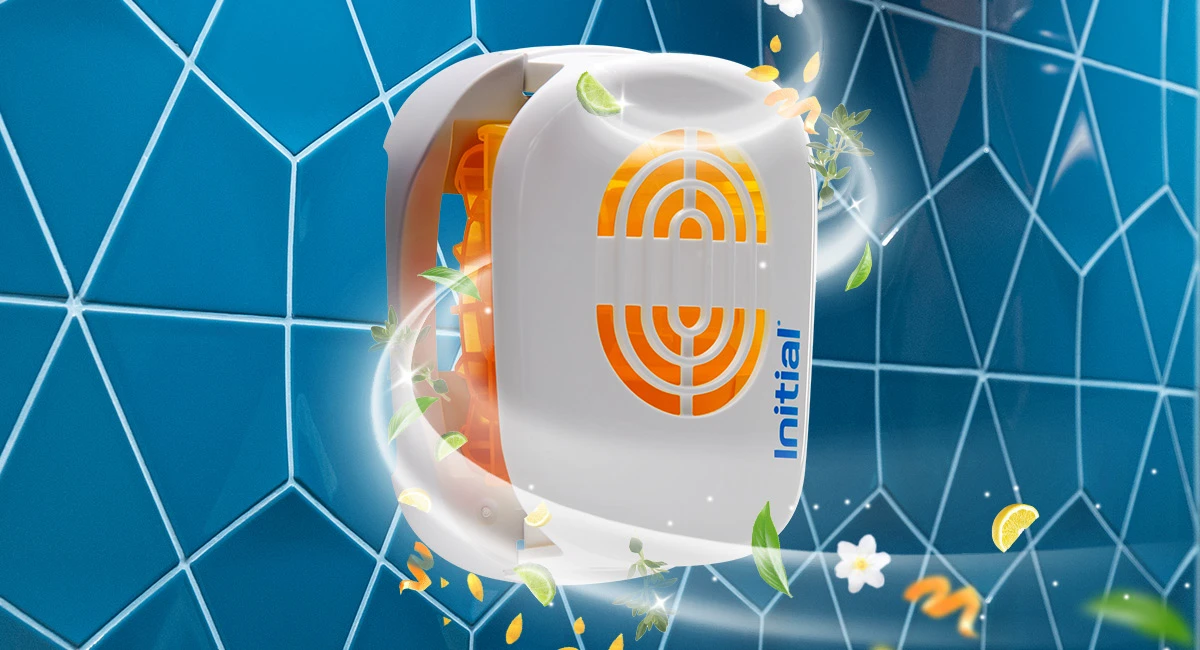
Designing our solution to use airflow has helped us achieve practical washroom fragrancing
for small washrooms and single cubicles without needing batteries, electric power sources,
aerosols or propellants.
You’ve learned how we designed it, but now discover Signature AirFlow Scent for yourself.
In addition to the battery, aerosol and propellant-free design, it features hardware made
from 70% post-consumer recycled plastic, is compatible with two exciting scents and can
reduce VOCs by up to 70%** when compared to aerosol fresheners.
Click here to find out what it can do for your business.
1 Initial, State of Air Care, 2017
*in washrooms up to 15m³ — performance may vary depending on room size, environment and climate
**by removing the need for a propellant fragrance dispersion, Signature AirFlow Scent reduces Volatile
Organic Compounds by 70% compared to standard 250ml aerosols
Initial's washroom ranges offer comprehensive solutions for clean and hygienic washrooms, ensuring optimal hygiene standards and user satisfaction